Mountain Biking in Pakistan: Choosing a Route and Preparing to Ride
Northern Pakistan offers some of the most dramatic cycling anywhere: the paved Karakoram Highway descending from the 4,693 m Khunjerab Pass, rough jeep tracks across the Deosai plateau, and passes such as Shandur in the Hindu Kush. The routes differ enormously in surface, altitude and remoteness.
This guide compares the four biking tours we publish, explains when to ride, and covers bikes, spares, traffic and altitude, so you can choose a route that matches how you like to ride.
The four routes at a glance
| Programme | Days | Best time | Highest point | Range / region |
|---|---|---|---|---|
| Hushe valley Biking Tour | 14 | Mid-May to End-August | 2750 m | Karakoram |
| Karakorum Highway Biking tour | 14 | Mid-June to End-September | 4,693 m | Karakoram |
| Deosai Biking Tours | 19 | — | — | — |
| HinduKush Mountain Bike | 19 | Mid-May to End-August | 3720 m | HinduKush/Karakoram |
From the published itineraries; the Deosai tour does not state a single duration or season.
Karakoram Highway: paved, high and spectacular
The Karakoram Highway Biking Tour is the most accessible ride. Vehicles carry the group up to Sost and the Khunjerab Pass, and the riding then runs mostly downhill on tarmac: Sost to Passu beneath its serrated peaks, along Attabad Lake to Gulmit, through the Attabad tunnels to Karimabad, and down past apricot orchards through Nagar to Gilgit. A rest day in Hunza allows a visit to Altit Fort and the Eagle's Nest viewpoint.
The surface is good, but this is a working road: trucks, buses and jeeps use it, and the tunnels need lights and care. The published season is mid-June to the end of September. Our guide to travelling the Karakoram Highway describes the road in more detail.
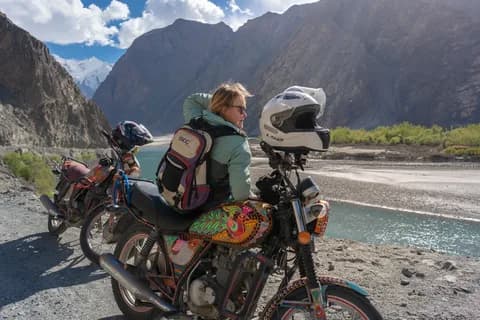
Deosai and Astore: rough tracks and a high plateau
The Deosai Biking Tour is the most demanding route. After a drive to Chilas and a jeep transfer along the Karakoram Highway towards Jaglot, the riding climbs into the Astore valley on rough tracks described in the itinerary as needing a lot of power and concentration, reaches Tarashing below the Rupal face of Nanga Parbat, and climbs over the Chhachor pass at about 4,100 m to Sheosar Lake. From there the route crosses the Deosai plateau via Barapani to Deosai Top and finishes with a long descent past Satpara Lake to Skardu.
Expect dirt, stones, stream crossings and several nights camping. It suits riders who are comfortable on loose surfaces at altitude for days at a time.
Hushe Valley: Baltistan back roads
The Hushe Valley Biking Tour starts from Skardu, where a day is set aside to acclimatise and test bikes, and follows the Indus and Shyok rivers to Khaplu before turning up the Hushe valley via Machulo to Hushe village and Saicho. The upper valley offers views of Masherbrum and access, partly on foot, towards the Charakusa glacier with K6 and K7. The surface becomes rugged and unpaved above Khaplu, with rocky climbs and river crossings.
Hindu Kush: Chitral, Kalash and Shandur
The 19-day Hindu Kush Mountain Bike Tour is the longest and most varied. From Dir the riding heads to Chitral, into the Kalash valley of Bumburet for a cultural rest day, then up the Mastuj valley via Buni and Laspur to the Shandur Pass, about 3,700 m, with a rest day at Shandur Lake before descending towards Phander and Gilgit. The itinerary mentions the Lowari Pass, about 3,118 m, and the Lowari Tunnel on the way north. Expect a mix of tarmac and long stretches of rough, unpaved track.
Preparing yourself and your bike
Bring your own bike
The itineraries start with bike assembly and a check-up on arrival, and the Deosai tour lists the mountain bike, spare parts and personal cycling gear as not included. Plan to bring a bike you know well, ideally a hardtail or full-suspension mountain bike with wide-range gearing for long climbs at altitude, and tyres suitable for gravel and stones. Ask us if you need help with alternatives.
Spares and tools
- Spare tubes or a tubeless repair kit, and spare tyres for the rough routes.
- A spare derailleur hanger for your frame, chain links, brake pads and cables.
- A multitool, pump, chain lube and rags; dust is constant on dirt roads.
- Lights for tunnels and late arrivals, and a helmet and gloves on every ride.
Altitude and fitness
Climbing on a bike at 3,500 m to 4,500 m is much harder than at home, and the Khunjerab and Deosai routes spend real time at that height. Build endurance with long rides on consecutive days, include sustained climbs, and read our guide to altitude sickness on Pakistan treks, which applies equally to cyclists.
Support and logistics
The biking tours list hotel accommodation, meals, air-conditioned transport and an English-speaking guide among the inclusions, and the Deosai tour adds camping equipment, a mountain cook and Deosai National Park entry fees. Domestic flights are listed where the itinerary flies to Skardu or Gilgit, and those flights depend on the weather, with the road as the fallback.
Frequently asked questions
Which biking route is easiest?
The Karakoram Highway tour, because it is paved and mostly downhill once vehicles have taken the group to the top. The Deosai route is the hardest, with rough tracks and a high pass.
Can I rent a bike in Pakistan?
The itineraries are built around riders bringing their own bikes, and the Deosai tour lists bikes and spares as not included. Ask us when you plan if bringing a bike is a problem.
When is the best time to cycle in northern Pakistan?
The published seasons run from mid-May to the end of August for the Hushe and Hindu Kush tours and from mid-June to the end of September for the Karakoram Highway. Deosai is only open in summer.
Is there vehicle support?
The tours include transport for transfers and overland sections. Ask us how vehicle support works on the riding days of your chosen route.
Do I need to be a mountain biking expert?
Not for the Karakoram Highway, which suits fit road and touring cyclists. The Deosai, Hushe and Hindu Kush routes need confidence on rough, loose surfaces.
Plan your ride
Tell us how you like to ride, the surfaces you are comfortable on and when you can travel, and we will help you choose. Browse the mountain biking page or contact us through the enquiry form.