The Peoples and Languages of Northern Pakistan
Northern Pakistan is one of the most linguistically and culturally varied mountain regions in Asia. Within a day's drive you can move from a valley where people speak Burushaski, a language unrelated to any other, to one where they speak Wakhi, related to languages of the Pamirs, and then to Baltistan, where Balti is a Tibetan language.
This guide introduces the main communities you will meet on our routes, the languages they speak and the traditions worth knowing about, so you can travel with more understanding and respect.
Languages you will hear
Urdu is Pakistan's national language and is understood almost everywhere, and English is widely used in tourism, hotels and education. At home and in the villages, though, people speak their own regional languages. Your guide will often switch between several in a single day.
Hunza and Nagar: Burushaski and Wakhi
Burushaski
In central Hunza, Nagar and the Yasin valley, many people speak Burushaski, a language isolate with no proven relationship to any other language in the world. The Burusho of Hunza were ruled for centuries by their Mirs from the forts of Baltit and Altit, and the princely states of Hunza and Nagar continued until 1974. Our Hunza Valley and Nagar Valley guides describe the valleys.
Wakhi
Upper Hunza, known locally as Gojal, around Gulmit, Passu and Sost, is home to Wakhi speakers. Wakhi belongs to the Pamir group of Iranian languages and is also spoken across the border in Afghanistan, Tajikistan and China. Gulmit's old house and museum, visited on our Gandhara tour, give a glimpse of traditional Wakhi life; see the Upper Hunza guide.
Gilgit, Astore and Chilas: Shina
Shina is the main language of Gilgit, Astore and the Diamer district around Chilas, and is spoken in parts of other valleys too. It belongs to the Dardic group of Indo-Aryan languages. If you travel the Karakoram Highway or visit Fairy Meadows and the Astore valley, Shina is the language you will hear most; see the Gilgit guide.
Baltistan: Balti
Baltistan, the region around Skardu, Shigar, Khaplu and Hushe, is home to the Balti people, whose language is Tibetan in origin and closely related to the languages of Ladakh. The region's forts, such as those at Shigar and Khaplu, were the seats of local dynasties, and its architecture, with carved wooden mosques and khanqahs, reflects both Tibetan and Islamic traditions. Many of the porters and high-altitude workers on the Baltoro come from Baltistan's villages.
Chitral: Khowar and Kalasha
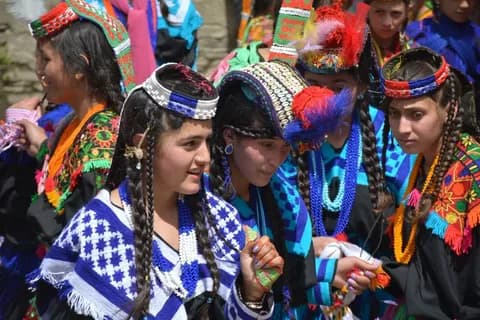
In Chitral, the main language is Khowar, which is also spoken in parts of Ghizer to the east. In three valleys south-west of Chitral town, Bumburet, Rumbur and Birir, live the Kalash, a small community with their own language, Kalasha, their own religion and a calendar of festivals. Kalash women's embroidered dresses and headdresses are famous. Our Kalash Valleys guide and Kalash festival tour describe the valleys and festivals.
Swat and the north-west: Pashto
In Swat, Dir and Peshawar, Pashto is the main language, and Pashtun hospitality traditions are strong. Several of our tours pass through these areas on the way to Chitral or to the Gandhara sites; see the Swat Valley guide.
Faith in the mountains
Most people in northern Pakistan are Muslim, but communities follow different traditions. Hunza is home to a large Ismaili community, many people in Nagar and Baltistan are Shia, parts of Baltistan such as Khaplu and Shigar have Noorbakhshi communities, and Sunni Muslims form the majority in areas such as Diamer. The Kalash keep their own distinct faith. Visitors are welcome in most mosques and shrines with modest dress and permission; ask your guide first. Our guide to responsible travel covers etiquette.
Useful tips for meeting people
- Assalam-o-alaikum, the standard greeting, works everywhere; your guide can teach you a greeting in the local language too.
- Ask before photographing anyone, and be especially careful with photographs of women.
- Accept tea when you can; hospitality matters a great deal.
- Ask about local history and crafts; people are often proud to explain them.
- Dress modestly in villages, and remove shoes when entering homes and religious buildings.
Crafts, architecture and music
Each community has its own crafts. Hunza is known for embroidery, woven caps and woollen goods, which you can find in the handicraft bazaar in Karimabad that several of our itineraries visit. Baltistan is known for fine woodwork, seen in the carved pillars and screens of old mosques and khanqahs such as the Chaqchan mosque in Khaplu and the Amburiq mosque in Shigar. The Kalash are famous for their embroidered dresses and beaded headdresses.
Traditional architecture is a highlight of any northern trip: the forts of Baltit and Altit in Hunza, and the restored forts of Shigar and Khaplu in Baltistan, show how local rulers lived and how buildings were designed for earthquakes and cold. Music and dance accompany weddings and festivals across the region, and at polo matches in Gilgit and at Shandur a band plays throughout the game. Our guide to forts and palaces describes the main buildings.
Frequently asked questions
Do people in northern Pakistan speak English?
Many people in tourism, hotels and towns speak English, and Urdu is understood almost everywhere. In villages, local languages such as Burushaski, Wakhi, Shina and Balti are spoken at home.
What language is spoken in Hunza?
Burushaski in central Hunza and Wakhi in upper Hunza (Gojal), with Shina in some villages. Urdu and English are widely understood.
What is special about Burushaski?
It is a language isolate: linguists have not proven a relationship between Burushaski and any other language.
Who are the Kalash?
A small community in three valleys near Chitral with their own language, religion and festivals. Visitors are welcome but should behave respectfully, especially during festivals.
Is Balti related to Tibetan?
Yes. Balti is a Tibetan language, closely related to the languages spoken in neighbouring Ladakh.
Plan a cultural trip
Our cultural tours and northern tours pass through many of these communities. Our guide to planning a cultural heritage itinerary helps you combine them, or contact us through the enquiry form.