
A Short History of Mountaineering in the Karakoram and Nanga Parbat
Pakistan holds five of the world's fourteen mountains above 8,000 m, and the story of how they were surveyed, explored and finally climbed is one of the great chapters of mountaineering. Knowing it adds depth to a trek up the Baltoro or a visit to Fairy Meadows: many of the campsites you pass were used by the expeditions described here.
This guide summarises the key moments, from the nineteenth-century surveyors to the first winter ascent of K2 in 2021.
Surveyors and explorers
In 1856 Thomas Montgomerie of the Great Trigonometrical Survey of India sighted a cluster of distant peaks in the Karakoram and labelled them in sequence: K1, K2 and onwards, with K standing for Karakoram. Most later received local names, but K2 kept its survey label, partly because it is so remote that it had no widely used local name.
Exploration of the Baltoro followed. Martin Conway's expedition of 1892 travelled up the glacier and gave Concordia its name, after the Place de la Concorde in Paris. In 1902 Oscar Eckenstein and Aleister Crowley made the first serious attempt on K2, and in 1909 an Italian expedition led by Luigi Amedeo, Duke of the Abruzzi, explored the mountain's flanks; the south-east ridge they tried is still called the Abruzzi Spur and became the line of the first ascent.
Nanga Parbat: the early tragedies
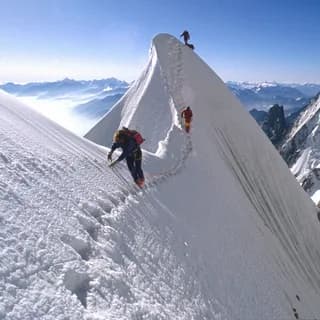
Nanga Parbat drew climbers early because it was easier to reach than the Karakoram giants. The British climber Albert Mummery disappeared on the mountain in 1895. German expeditions in the 1930s, approaching from the Rakhiot side above Fairy Meadows, ended in heavy loss of life, which gave the mountain its grim reputation.
The first ascent came on 3 July 1953, when the Austrian Hermann Buhl reached the summit alone in a famous final push from the last camp of a German-Austrian expedition. The Rakhiot approach he used is the valley that our Fairy Meadows trek walks up to base camp, and our Nanga Parbat route guide describes the mountain's other sides.
K2: from failure to the first ascent
American expeditions attempted K2 in 1938, 1939 and 1953 and came close, but each ended in retreat, and the 1939 and 1953 attempts in tragedy. The 1953 expedition is remembered for the attempt to bring down the sick climber Art Gilkey and for a fall that the team survived when one climber held several roped companions.
On 31 July 1954 an Italian expedition led by the geologist Ardito Desio put Achille Compagnoni and Lino Lacedelli on the summit via the Abruzzi Spur. The ascent was supported by Walter Bonatti and the Hunza high-altitude porter Amir Mahdi, who survived an unplanned night in the open at about 8,100 m and paid for it with severe frostbite. Their story is now recognised as central to the success of the expedition.
Pakistani climbers on K2
Ashraf Aman became the first Pakistani to reach the summit of K2 in 1977, with a Japanese expedition, and Nazir Sabir followed in 1981. In 2022 Samina Baig became the first Pakistani woman to stand on the summit. High-altitude porters and climbers from Hunza, Nagar and Baltistan have been essential to almost every expedition on these mountains.
The golden age of first ascents
Within a few years of K2, the other great peaks of the Baltoro were climbed for the first time:
- Gasherbrum II (8,035 m): first climbed by an Austrian expedition in July 1956.
- Broad Peak (8,051 m): first climbed in June 1957 by a small Austrian team that included Hermann Buhl and Kurt Diemberger, in a lightweight style that was ahead of its time.
- Gasherbrum I, also called Hidden Peak (8,080 m): first climbed by an American expedition in July 1958.
- Gasherbrum IV: first climbed by Walter Bonatti and Carlo Mauri in August 1958.
- Rakaposhi: first climbed in 1958 by a British-Pakistani forces expedition.
- Masherbrum: first climbed in 1960 by an American-Pakistani expedition.
Gasherbrum III, the Trango Towers and new styles
Gasherbrum III (7,952 m), the objective of our 7,000 m expedition, was first climbed in August 1975 by a Polish expedition whose summit team included Wanda Rutkiewicz and Alison Chadwick-Onyszkiewicz; at the time it was one of the highest unclimbed summits in the world. A year later, in 1976, a British team made the first ascent of the Trango Tower, opening the era of big-wall climbing on Karakoram granite that continues today in places such as Nangma; see our Nangma Valley guide.
Winter ascents
For decades the 8,000 m peaks of Pakistan resisted winter climbers. Nanga Parbat was first climbed in winter on 26 February 2016 by Simone Moro, Alex Txikon and Muhammad Ali Sadpara of Pakistan. K2, the last 8,000 m peak without a winter ascent, was finally climbed in winter on 16 January 2021 by a team of ten Nepali climbers who walked the last metres to the summit together.
Seeing the history for yourself
A trek up the Baltoro passes the campsites of almost every expedition named here. Our K2 Base Camp trek reaches Concordia and the base of K2, and our guide to Concordia and the Baltoro glacier describes the landscape. In Skardu and Hunza you may meet climbers and high-altitude porters whose families have worked on these mountains for generations.
Frequently asked questions
Why is K2 called K2?
It is the survey label given in 1856 by Thomas Montgomerie, K for Karakoram and 2 for its place in his list. Unlike most peaks in the series, it never took on a widely used local name.
Who first climbed K2?
Achille Compagnoni and Lino Lacedelli of an Italian expedition led by Ardito Desio, on 31 July 1954, via the Abruzzi Spur.
Who first climbed Nanga Parbat?
Hermann Buhl, on 3 July 1953, reaching the summit alone on the final day of a German-Austrian expedition.
When was K2 first climbed in winter?
On 16 January 2021, by a team of ten Nepali climbers.
How many 8,000 m peaks are in Pakistan?
Five: K2, Nanga Parbat, Gasherbrum I, Broad Peak and Gasherbrum II. Our guide to Pakistan's 8,000 m peaks introduces each one.
Plan your journey to the great peaks
Whether you want to trek to the base of K2 or attempt a summit, we can help you plan. Browse our expeditions and trekking routes, or get in touch through the contact page.