
Photography in Northern Pakistan: Where, When and How to Shoot Respectfully
Northern Pakistan rewards photographers with huge mountain faces, glacial lakes, blossom and autumn colour, and ancient forts, often all on the same trip. Getting good pictures depends on timing, on looking after your equipment at altitude and in dust, and on knowing the local rules and customs about photographing people and places.
This guide brings together the viewpoints on our itineraries, the seasons for colour, practical camera care and the etiquette that matters.
Viewpoints on our routes
Many of the classic views of the north are already part of our itineraries. Plan your days so that you reach them at the right time of day.
- Duikar, above Karimabad in Hunza, which several itineraries visit for sunset over the surrounding peaks; see the Hunza Valley guide.
- The Rakaposhi viewpoint on the Karakoram Highway, where the mountain rises directly above the road.
- Attabad Lake and the Passu area in upper Hunza, with turquoise water and serrated peaks; see the Upper Hunza guide.
- Fairy Meadows, where still pools reflect the Rakhiot face of Nanga Parbat early in the morning.
- Concordia on the Baltoro glacier, surrounded by K2, Broad Peak and the Gasherbrums.
- Sheosar Lake and the open grasslands of the Deosai plateau.
- The lakes around Skardu, including Kachura and Satpara; see our guide to the lakes around Skardu.
- Baltit, Altit, Shigar and Khaplu forts, best in soft light when shadows bring out the woodwork.
Seasons and light
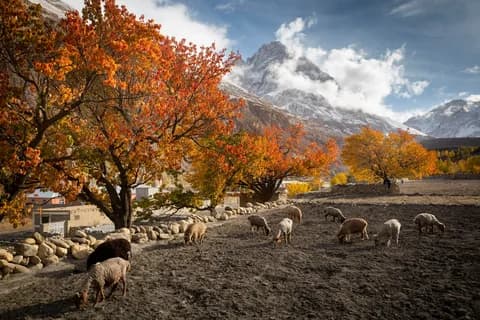
Blossom and autumn colour
Two seasons attract photographers above all. Our cherry blossom tour is published for mid to late March, when orchards in the valleys flower against snowy peaks, and our autumn tour is published for mid to late October, when poplars, apricots and other trees turn gold and red. Exact timing varies with the year and with altitude.
High-altitude light
At altitude, midday light is harsh and the sky can turn very dark blue in photographs. The best light is usually in the first and last hours of the day, which is also when mountains are most often clear of cloud. A polarising filter helps with glare on water and snow, but use it lightly at altitude to avoid an unnaturally dark sky.
Summer haze and dust
In summer, dust and haze in the lower valleys can soften distant views, while high camps are often crystal clear in the early morning. Plan important shots for mornings and after rain, when the air is clearest.
Looking after your equipment
- Cold drains batteries quickly. Carry spares and keep them warm inside your jacket or sleeping bag at night.
- Dust is constant on jeep tracks. Change lenses inside a vehicle or a bag, and carry a blower and cleaning cloths.
- Power is limited on treks. Bring a power bank or a small solar charger, and charge everything whenever you are in a hotel.
- Protect equipment from knocks on jeep roads and from moisture during river crossings and snow.
- Back up your images regularly to a second card or device during the trip.
Photographing people and places respectfully
People in the north are generally welcoming, but always ask before photographing anyone, and accept a refusal gracefully. Be especially careful about photographing women; in many communities it is best not to, unless you are clearly invited to. Photographing people at prayer or in mosques is inappropriate. Our responsible travel guide explains these customs in more detail, including at Kalash festivals.
Sensitive sites
Do not photograph military installations, checkpoints, airports or soldiers, and be cautious around bridges and border areas such as the Khunjerab Pass. If an official asks you not to photograph something, comply.
Archaeological sites and museums
Some heritage sites and museums charge for cameras or restrict filming. Our cultural tours list government archaeological photography permits among the inclusions, while professional documentary or commercial filming fees are excluded and need to be arranged separately.
Drones
Drones are tightly regulated in Pakistan. Current regulations require drones to be registered with the Pakistan Civil Aviation Authority, and travellers report that drones arriving without clearance can be confiscated at customs; permission to fly near sensitive areas is rarely granted to visitors. Rules and enforcement can change, so check with the authorities well before you travel, and do not bring a drone unless you have the necessary clearance.
Planning a photography-friendly itinerary
- Build in spare days. Mountains are often hidden by cloud, and an extra night at Fairy Meadows, Karimabad or Concordia greatly improves your chance of a clear morning.
- Sleep close to the view. Staying in Karimabad or at Fairy Meadows lets you be in position at first light without a long drive in the dark.
- Match the season to the subject: March for blossom, summer for high lakes and treks, mid to late October for autumn colour.
- Allow time at stops. Tell your guide in advance which viewpoints matter most so the day can be planned around the light rather than the road.
- Expect flights to be weather-dependent. If you have a fixed shot list, keep a buffer day before your international flight home.
Frequently asked questions
Can I bring a drone to Pakistan?
Only with the required registration and clearance from the Pakistan Civil Aviation Authority, arranged well in advance. Without it, a drone may be confiscated. Check the current rules before you travel.
When is the best time for photography in northern Pakistan?
March to April for blossom and October for autumn colour are the favourites, but summer is the season for the high treks and lakes. Early mornings are best in every season.
Is it okay to photograph local people?
Ask first, every time, and respect a refusal. Be particularly careful with photographs of women, and avoid photographing people at prayer.
Can I charge camera batteries on a trek?
There is usually no mains power on treks. Bring spare batteries, a power bank or a small solar charger.
Are there extra fees for cameras at heritage sites?
Some sites and museums charge for photography or restrict filming. Our cultural tours include archaeological photography permits; commercial filming fees are extra.
Plan a trip for photographers
Tell us what you want to photograph and when you can travel, and we can suggest an itinerary that reaches the right places at the right time of day. Start with our tours or contact us through the enquiry form.